Our Aims
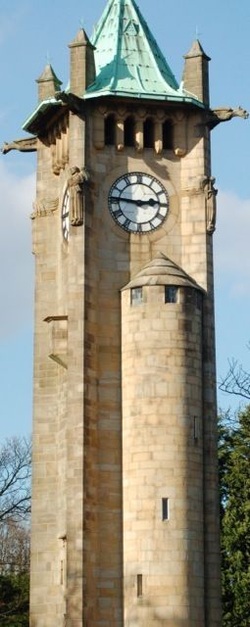
Lindley Clock Tower, Huddersfield
The great architectural historian Sir Nikolaus Pevsner praised Edgar Wood for his originality and some of his greatest buildings can still be found in Yorkshire where Wood had close family connections. The Edgar Wood Heritage Group (Yorkshire) is dedicated to raising the awareness of the work of Edgar Wood, especially in Yorkshire, encouraging and carrying out research on Edgar Wood and his influence in the region and lobbying to ensure the preservation and enhancement of his work. The Group is in the process of creating an archive of Wood’s work and related subjects. Activities have included the opening to the public and interpretation of Wood’s buildings on Heritage Open Days, the organisation of lectures on the work of Edgar Wood and associated topics as well as the preparation of publications on aspects of Wood’s work in the region. Anthony Dolan's feature-length documentary, A Painted Veil, is now available on YouTube. It profiles the life and work of Edgar Wood from his birth in 1860 to his death in 1935 in Monte Calvalo (Italy) where he spent his retirement. It shows how Wood was a pioneer of Art Nouveau and the Modern Movement in architecture. https://www.youtube.com/watch?v=EaH5DVYjKUo |
|
NEW BOOK CELEBRATES TOWN’S MANY ARTS & CRAFTS HOUSES
A new book from Huddersfield Local History Society, Huddersfield’s Arts & Crafts Houses: from Edgar Wood to the 1930s, celebrates some of the town’s best-designed homes from the late 19th and early 20th centuries, and the developers and architects who created them.
The pioneering architect Edgar Wood is well-known for his work in Lindley and Birkby from the turn of the 19th century, including Lindley Clock Tower, Banney Royd and Briarcourt, and the book starts with an exploration of his Huddersfield work. He was a devotee of the Arts & Crafts movement, devoted to the use of local materials, traditional local styles, hand craftsmanship, functional design and the artistic unity of all elements of a house and its contents.
Less well-known than Wood, however, are the local architects he influenced, and who carried these ideals forward in the 20th century – designing high-quality houses in a ‘Pennine vernacular style’. Leading figures whose work is described include Wood’s own pupil Dennis Bamford, Willie Cooper, John Cocking, Oswald White, John Lunn, Clifford Hickson and Norman Culley.
Many of their houses were commissioned by individual private clients, and most of these are identified in the book. But there were also ambitious schemes of suburban development, notably the Avenues Estate at Fartown, the Hope estate (Daisy Lea Lane) in Lindley, Birkby’s Oakfield estate and Toothill Park at Fixby – and some unrealised schemes too. Their developers included the painter and decorator Albert Lunn, the accountant George Pepler Norton, and the builders John Jagger & Sons. These areas are all fully explored, as are individual properties in Almondbury, Beaumont Park, Greenhead, South Crosland and elsewhere in the town.
The book has been written by David Griffiths, author of The Villas of Edgerton and co-chair of the Local History Society, with photographs taken specially by Alan Stopher of the Huddersfield Photo-Imaging Club, and numerous maps and plans. David comments: ‘Ever since I became aware of Edgar Wood’s local work, I’ve been intrigued to spot other “Woodish” houses around the town. It has been a joy to research their stories, identify their unsung architects, and in many cases meet owners who have generously allowed access to their homes.’
Craig McHugh of English Heritage, who lives locally, says: ‘The book will highlight what an incredibly rich Arts and Crafts legacy Huddersfield has and how easily it can be missed behind high hedges and in leafy suburbs!’ And Richard Fletcher of the Edgar Wood Society adds: ‘What a huge amount of painstaking research. I'm sure the book will become a standard reference work.’
The book is priced at £12.95 for 132 large-format pages, with over 90 illustrations, and is available from local bookshops (from 24 November 2025) or via the Huddersfield Local History website, www.huddersfieldhistory.org.uk/publications.
